Lock dedicated Android phones, tablets, rugged devices and POS terminals into one app, an approved app set or a secure website - then manage every kiosk remotely from one console.
Android kiosk mode locks a phone, tablet or POS terminal into a controlled business experience. Choose one app, an approved app set or a secure website, then manage every device remotely from LimaxLock.
Prevent misuse
Increase productivity
Reduce support costs
Secure company devices
Enforced through Android Enterprise Device Owner and Lock Task Mode, so the policy survives reboots and only an administrator can change it.
Rugged HandheldsScanners and vehicle-mounted devices
POS TerminalsCheckout and self-service registers
Choose the experience
Which Android kiosk mode fits the job?
Start with what the user should be able to do. LimaxLock applies the same Android Enterprise foundation to single-app, multi-app and browser kiosk mode.
One consoleOne policy engine3 controlled experiences
01Single-app
Keep one application in control
Single-app kiosk mode opens one business app on boot and keeps it in the foreground. Home, Recents, notifications and system settings stay out of reach; an admin PIN or remote command is required to exit.
Choose this for
POS, ordering, visitor check-in and other single-purpose devices.
Launches again after a restart
Prevents users switching apps
Keeps the customer flow distraction-free
App always active
TASTY BITESSelf Order
Signature Combo$12.90
Touch to Order
02Multi-app
Give teams an approved workspace
Replace the Android home screen with a managed launcher that shows only the work apps you approve. Add, remove or update that app set over the air.
TeamsChromeGmailOutlook
Approved apps only
Choose this for
Field service, delivery, warehouse and shared employee devices.
03Browser kiosk
Turn a web workflow into the whole device
Run one website or an allowlist in a full-screen browser. Hide the address bar, block downloads and keep navigation inside the approved experience.
portal.company.comAllowed
Choose this for
Booking, check-in, forms, portals and browser-based POS.
Choose by workflow, not by device label. This table summarizes what users see, how each configuration starts and what administrators can change remotely.
Decision
Single-app
Multi-app
Browser kiosk
Best fit
One fixed business workflow
A small approved employee toolset
Web apps, forms and self-service portals
User sees
One full-screen application
A managed launcher with approved apps
One website or an allowed site list
Startup behavior
Assigned app opens after boot
Managed launcher becomes the workspace
Controlled browser opens the approved destination
Remote changes
Replace or update the assigned app
Add, remove or update approved apps
Edit destinations and browser restrictions
Typical use
POS, ordering, check-in, digital forms
Warehouse, delivery, field service, shared devices
Android Enterprise enrollment, device restrictions and app or website allowlists work together as one managed configuration - not separate settings someone must maintain on each device.
1EnrollDevice Owner2ConfigureKiosk profile3AssignDevice or groupEnforcedAt OS level
Retail kiosk / Restrictions
Policy saved
Navigation
Home & Recents buttonsBlocked
NotificationsConditional
Security
Settings appBlocked
Factory resetBlocked
ScreenshotsBlocked
Connectivity & Hardware
USB file transferBlocked
Wi-Fi & BluetoothManaged
CameraAllowed
Allow by exception
Only approved apps and sites appear
Define the working set once. Everything outside it remains hidden or blocked, and changes sync without rebuilding the kiosk.
LimaxLock is provisioned as Device Owner and uses Android Lock Task Mode to enforce the kiosk experience. The profile returns after a restart and remains under administrator control.
OS-level kiosk enforcement
Admin-controlled exit
Remote policy changes
Policy active
Remote management
Keep every kiosk working without visiting it
See device state, change a kiosk profile, update an app or recover a device from one console. Assign policies by group when an entire site or workflow needs to change.
Respond remotely with lock, restart, sync and exit commands.
Change the experience by updating apps, sites or kiosk mode.
Manage by group across stores, teams, sites or device types.
Validate the Android device, enrollment and workflow
Phones, tablets, rugged handhelds and POS terminals can run a managed kiosk experience when they support the required Android Enterprise provisioning. Exact restrictions vary by Android version, manufacturer and enrollment method.
01
Device ownership
Use company-owned, fully managed enrollment for the strongest control. Device Owner status lets LimaxLock apply Android enterprise policy across the complete device.
02
Provisioning route
Choose QR enrollment for hands-on setup, or eligible Android zero-touch and Samsung Knox Mobile Enrollment hardware for automated provisioning.
03
App and web dependencies
Test background services, authentication, redirects, peripherals and connectivity before finalizing the kiosk profile.
04
Recovery plan
Define administrator exit, then test reboot, app update, weak connectivity and offline recovery on the production model before fleet assignment.
Compatibility policy: LimaxLock does not assume that every control behaves identically on every Android build. Use the trial to validate the exact device model and firmware intended for production.
Product evidence
Review the device and console experience
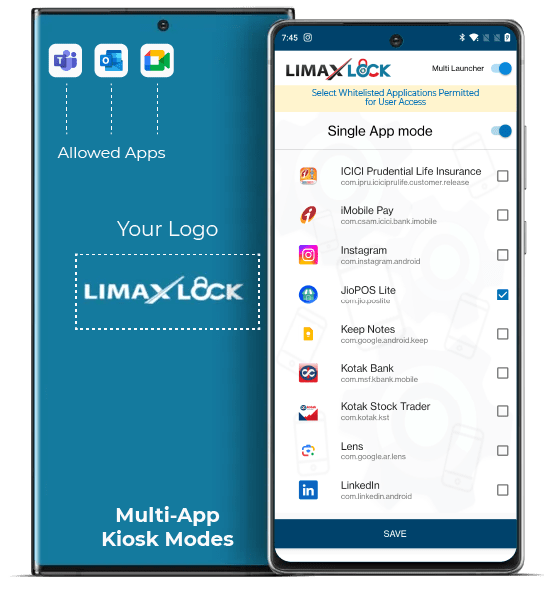
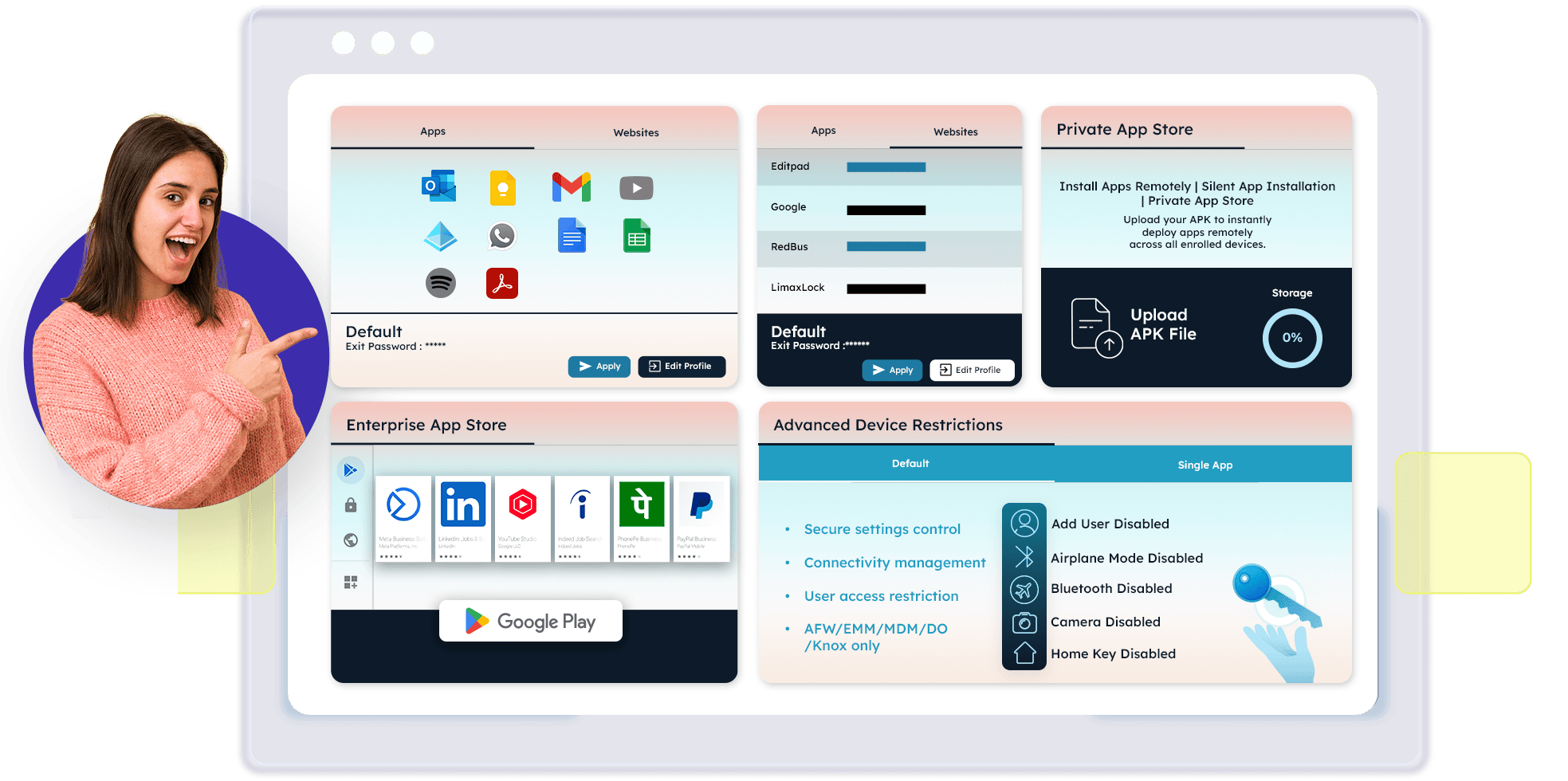
See how applications are selected on the device and managed from the LimaxLock interface, then reproduce the configuration on a pilot device.
Device configurationSelect one application or present a branded launcher containing the approved work apps.Central managementConfigure applications, websites and device restrictions from the wider LimaxLock console.
Where it fits
Match kiosk mode to the workflow
The best kiosk setup is defined by the job, not the device label. Use one profile for a focused customer flow, an approved workspace or a controlled web experience.
TASTY BITESSelf Order
Signature Combo$12.90
Touch to Order
Single-appPOS terminal
Retail & POS
Keep checkout and self-order terminals inside the transaction flow, with Android controls out of customer reach.
Visitor Check-In
Continue
Single-appTablet
Healthcare
Run patient or visitor check-in as a focused, full-screen experience on a shared tablet.
Inventory
SKU 4820-11 · 342 units
Multi-appRugged handheld
Warehouse & Logistics
Give operators the scanner, inventory and dispatch tools they need while hiding personal apps and settings.
portal.acme-retail.com
Browser kioskTablet or terminal
Self-Service Portals
Turn a booking, registration or information website into an unattended, full-screen kiosk.
Make the right choice
Kiosk mode vs. Android screen pinning
Both can keep one app visible. Only managed kiosk mode is designed for dedicated business devices that need policy, fleet control and remote administration.
Capability
LimaxLock
Screen pinning
Enterprise management
Yes
No
Remote configuration
Yes
No
Prevent app exit
Yes
Limited
Multi-app support
Yes
No
Device restrictions
Yes
No
Remote deployment
Yes
No
Deployment
How to set up Android kiosk mode
Move from a pilot device to a managed fleet with one repeatable profile and a rollout plan your support team can trust.
01
Enroll the Android device
Provision it as a fully managed Android Enterprise device with LimaxLock as Device Owner.
02
Choose the kiosk experience
Select single-app, multi-app or browser mode for the role the device needs to perform.
03
Set content and controls
Approve the apps or websites, restrict system functions and define how an administrator can exit.
04
Test, assign and roll out
Validate the profile on a pilot device, then assign it to one device or a managed group.
Fleet proof
A kiosk platform backed by real Android fleet adoption
Kiosk mode turns a general-purpose device into a controlled business device. It can keep one app open, show only an approved set of apps, or run a website full-screen while hiding the rest of Android.
What is Android kiosk mode?
Enterprise Android kiosk mode uses Android Enterprise management APIs, including Device Owner and Lock Task Mode, to enforce a controlled experience. With LimaxLock, the kiosk profile returns after a restart and remains under administrator control instead of relying on a user-level app that can simply be closed.
What is the difference between single-app and multi-app kiosk mode?
Single-app kiosk mode keeps one application in the foreground and blocks access to the rest of Android. Multi-app kiosk mode replaces the home screen with a managed launcher containing only approved work apps. Use single-app for one fixed workflow and multi-app when a user needs a small toolset.
What is kiosk browser mode?
Kiosk browser mode runs one website or an allowlist in a controlled, full-screen browser. Administrators can hide the address bar and tabs, limit navigation, block downloads and keep the session inside approved web workflows such as booking, check-in or browser-based POS.
How do I put an Android tablet or phone into kiosk mode?
Provision the device as fully managed with LimaxLock, create a kiosk profile, choose the mode, approve the required apps or sites, and set the restrictions. Test the profile on one device before assigning it to a larger group.
What is Android Enterprise kiosk management?
Android Enterprise kiosk management means a business provisions a device as fully managed and assigns an enterprise mobility management provider as Device Owner. That management state allows kiosk mode, restrictions and administrative commands to be applied through Android's enterprise APIs.
What is the difference between kiosk mode and screen pinning?
Screen pinning is a local Android feature for temporarily keeping one app visible on a nearby device. Managed kiosk mode is configured centrally for dedicated devices, can include restrictions and allowlists, returns after restart, and can be changed or exited remotely by an administrator.
Can Android kiosk mode be managed remotely?
Yes. From the LimaxLock console, administrators can change the kiosk profile, update approved apps or sites, sync policy, restart or lock a device, and apply changes to one device or a managed group.
Can kiosk mode block access to Android settings and other apps?
Yes. A kiosk profile can block the Settings app and restrict navigation, notifications, screenshots, USB transfer and selected connectivity or hardware functions. The exact controls available depend on the Android version, device manufacturer and enrollment mode.
Which devices support Android kiosk mode?
Android phones, tablets, rugged handhelds and POS terminals can support kiosk mode when they can be provisioned as fully managed Android Enterprise devices. Compatibility and available restrictions vary by Android version, manufacturer and provisioning method, so test your production device model before rollout.
How much does kiosk mode software cost?
LimaxLock pricing is based on managed devices. You can start with a 14-day free trial, with no credit card required, to validate your kiosk profile on real devices before choosing a paid plan.
Ready to launch your first Android kiosk?
Start a free 14-day trial, enroll a pilot device and test single-app, multi-app or browser kiosk mode before you roll it out to the fleet.